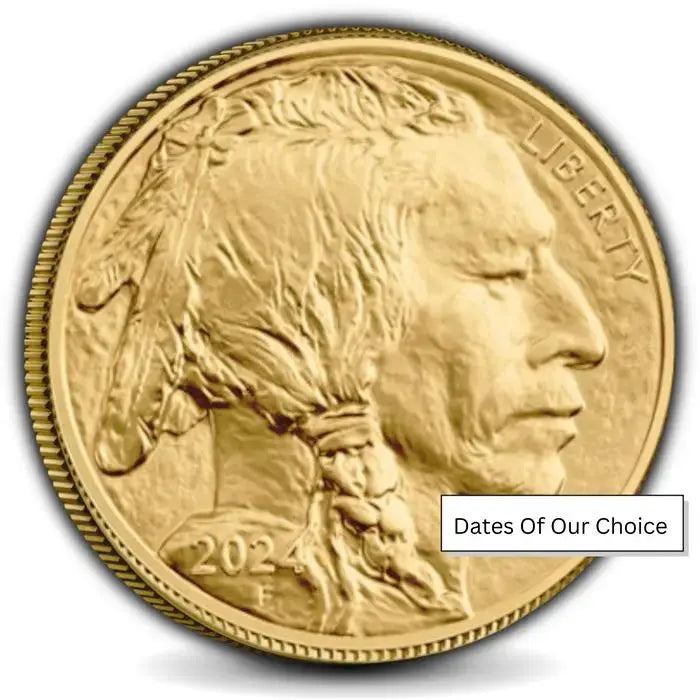
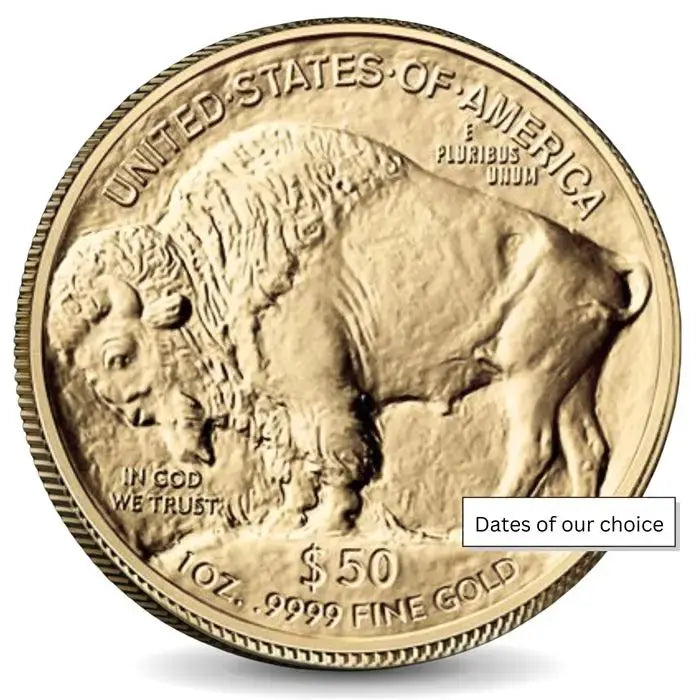
One 1 oz American Gold Buffalo, .9999 fine gold, Brilliant Uncirculated, year of our choice.
The American Gold Buffalo is the U.S. Mint’s 24-karat bullion coin: one troy ounce of .9999 fine gold, 32.70 mm across, with a $50 face value [1]. We choose the year. This listing is one coin in Brilliant Uncirculated condition.
Want a set year? See the 2026 Gold Buffalo. Compare the random-year Gold Eagle or browse American Gold Buffalos.
The Mint’s first .9999 gold coin.
The U.S. Mint says the Gold Buffalo was the first .9999 fine, 24-karat gold coin it ever struck [1].
Specifications
| Purchase unit |
One coin |
| Year |
Our selection |
| Condition |
Brilliant Uncirculated (BU) |
| Issuer |
United States Mint |
| Gold content |
1 troy oz (31.103 g) |
| Fineness |
.9999 (24 karat) |
| Diameter |
32.70 mm |
| Face value |
$50 (U.S. legal tender) |
| Design |
James Earle Fraser, both sides |
| Packaging |
Plastic flip |
| IRA |
Bullion may qualify; ask your custodian |
Specifications from the U.S. Mint. Year selection, condition and packaging describe Anchor’s offer.
What is a random-year Gold Buffalo?
It’s one 1 oz Gold Buffalo in Brilliant Uncirculated condition, with the year chosen by us. The coin you receive may not show the year in the photo. Every year holds the same one troy ounce of .9999 fine gold [1].
Does a Gold Buffalo have more gold than a Gold Eagle?
They hold the same amount of gold. The Gold Buffalo is .9999 fine, 24-karat gold [1]. The 1 oz American Gold Eagle is a 22-karat alloy that by law contains one troy ounce of fine gold [2], so it weighs more in total but holds no extra gold. Pick the one you like, then compare live prices per ounce.
Who designed the Gold Buffalo?
James Earle Fraser designed both sides [1]. He first used the Native American portrait and the American bison on the Buffalo nickel, which the U.S. Mint struck from 1913 to 1938 [3]. The gold coin brings that design back in 24-karat gold.
Is a random-year Buffalo cheaper than the 2026 coin?
Not always. A random year makes sense when the date doesn’t matter to you. Both coins hold the same gold, so compare their live prices at the same payment method. Our guide to premiums over spot explains how.
How is the coin packed?
Gold coins ship in plastic flips. No mint box, capsule or grading holder comes with this coin. BU describes the coin’s uncirculated condition. It isn’t a numerical grade such as MS70.
Random-year Buffalo, 2026 Buffalo or Gold Eagle?
All three hold one troy ounce of gold. Choose the coin and date terms you want, then compare live prices.
-
Random-year Buffalo: 24-karat gold, year of our choice.
-
2026 Buffalo: 24-karat gold, 2026 date.
-
Random-year Gold Eagle: 22-karat alloy, same gold content.
Questions about the random-year Gold Buffalo
Can I choose the year?
No. We choose the year. For a set date, buy the 2026 Gold Buffalo.
Will several coins have different years?
Not necessarily. Coins in one order may share a year.
How much gold is in a Gold Buffalo?
One troy ounce of .9999 fine gold, which is 31.103 grams. [1]
Does BU mean MS70?
No. BU means Brilliant Uncirculated. It isn’t a grade from a grading service.
What does the $50 face value mean?
It’s the coin’s U.S. legal-tender value. The coin’s price comes from its gold content. [1]
Can this coin go in an IRA?
The IRS allows gold bullion of a certain fineness in an IRA when a bank or approved trustee holds it. This coin is .9999 fine gold, but ask your IRA custodian before buying for an IRA. [4]
Sources
- U.S. Mint — Bullion coin programs (American Gold Buffalo specifications)
- 31 U.S.C. § 5112 — U.S. coin specifications, including the American Gold Eagle
- U.S. Mint — Nickel history, including the Buffalo nickel
- IRS — collectibles in retirement accounts and the bullion exception